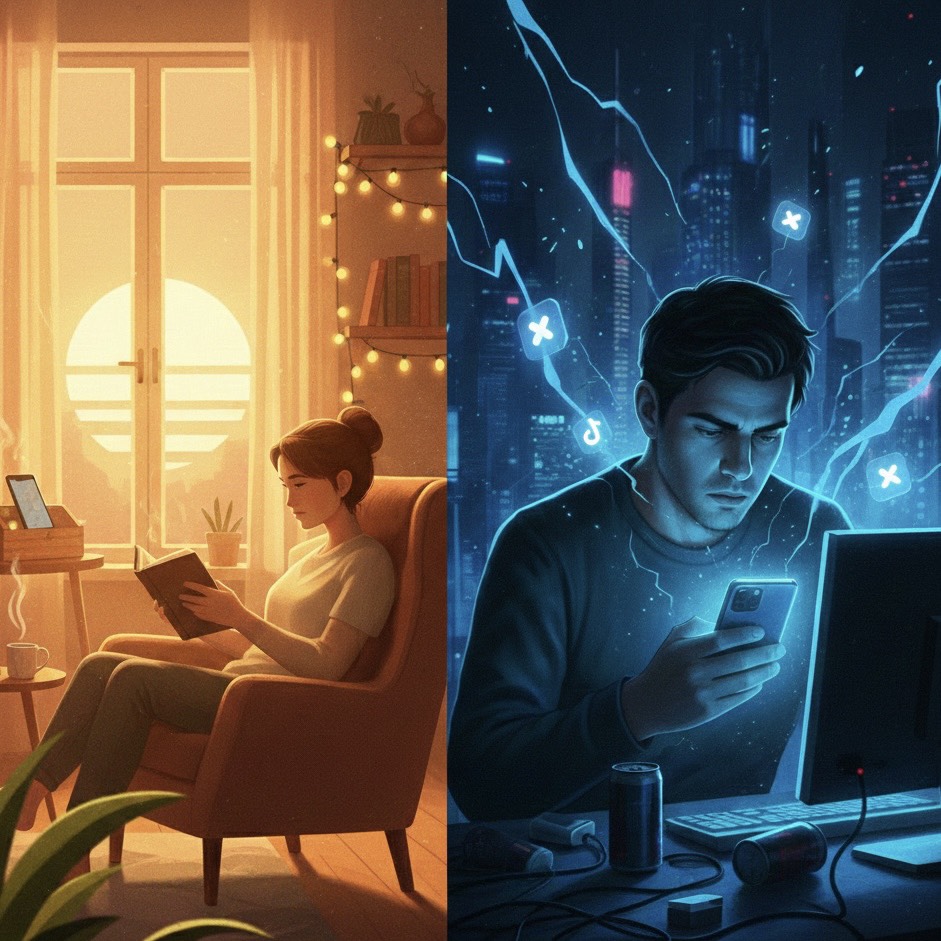
Another year came, and people were still discussing how AI makes humans more distant from nature. However, in 2026, it gained more popularity, and people began to call for a greater emphasis on nature over technology. However, on the other hand, nature became closer to human society.
“Analogue wellness” is a growing movement focused on finding a healthier balance between our digital and physical lives. As our world becomes more technologically integrated, many are seeking ways to disconnect and mitigate the negative effects of constant stimulation.
This article from Medium, written by Dr. Cameron Sepah, has received 140K+ views. The international media, including ABC, The New York Times, BBC, and other prominent outlets, have covered it across the US, UK, Australia, Finland, France, Japan, India, Russia, Turkey, and the Middle East.
In it, he mentions a technique to manage addictive behaviors by restricting them to specific periods of time – or fasting – to regain behavioral flexibility.
What is “Dopamine Fasting 2.0”?
Forget the old 2019 fad of sitting in a dark room doing nothing. In 2026, Dopamine Fasting 2.0 is about stimulus management.
The Theory: Our brains have become “desensitized” to pleasure because of constant pings and infinite scrolls.
The 2-Hour Reset
The “Cognitive Fatigue” of 2026
This reduction in and of itself drove some of the positive effects on wellbeing – but not all of them. A second factor had to do with time. Essentially, people spent less time on their phones, freeing up about 2.o hours per day for other activities, such as reading or spending time outdoors. The final factor had to do with attention: with no internet on their phones, people felt less distracted. Beyond the effects on subjective feelings of wellness and attention, we found that, after two weeks on a dumbphone, essentially, people with ADHD perform better.
When adopting a digital detox practice, you need to be thinking about three things. First, you need to decide which of the content you consume is ‘toxic’ for your wellbeing – eg, a certain have many social media application where you tend to doomscroll – and avoid or reduce it.
Second, you should replace at least part of this toxic content with non-digital activities you might enjoy with people who make content that you know makes you happy. Without content on social media, you might get bored more easily, because your brain is addicted to dopamine from stimulating content on social media. And instead, this can be replaced by reading, exercising, or other hobbies.
Finally, you need to make sure that you introduce limits to the distractions from your phone, so that you and those around you can reap the full benefits of those activities. And it’s recommended to keep these limited to 2 hours per day, which scientists say is the perfect amount of time to focus on something.
However, I do understand that most people stay on social media more than that in the real world, but nonetheless, it’s still important to make me-time to go outside and meet real people, to develop your social skills and get closer to nature.
However, dumping your phone and being more relaxed can help your brain release Serotonin in a balanced way and improve your sleep quality.