What is Flow?
Flow is that elusive yet electrifying state where you’re fully immersed in an activity, losing track of distractions and self-consciousness. Imagine a musician lost in a performance, a climber scaling a rock face with precision, or a writer so engrossed in drafting a story that hours feel like minutes. Challenges align perfectly with your skills in flow, creating a harmony between effort and enjoyment.
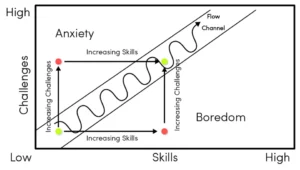
Core Concept:
Flow state, also known as “being in the zone,” is a mental state where a person is fully immersed in an activity, feeling a sense of energized focus, full involvement, and enjoyment in the process. It’s a state of deep absorption where time seems to pass quickly, and the individual is so engrossed in the activity that they lose self-consciousness.
Flow and Neuroscience in Stress
Understanding the brain’s response can empower you:
- Dopamine Surge: Flow releases dopamine, which boosts motivation and offsets stress.
- Cortisol Reduction: Deep focus lowers stress hormones, creating a natural calm.
- Neuroplasticity: Repeated flow states rewire the brain to handle future challenges more effectively.
Why Flow Matters
Beyond productivity, flow is a gateway to fulfillment, I found that people in flow report higher life satisfaction, creativity, and resilience. Flow transforms mundane actions into sources of joy and meaning, whether in work, or daily tasks.
Mihaly Csikszentmihalyi’s Work: Start by introducing the concept of “flow state” defined by Mihaly Csikszentmihalyi, the psychologist who pioneered this research. Explain that it’s a state of deep absorption and engagement in an activity, where time seems to disappear, and you’re fully focused and enjoying the process.
Intense and Focused Concentration on the Present Moment: Attention is completely fixed on the activity at hand, blocking out distractions and worries. You’re fully present.
Merging of Action and Awareness: There’s a seamless connection between what you’re doing and your awareness of doing it. You’re not thinking about your actions; you’re just doing them.
Loss of Reflective Self-Consciousness: Worries about self-image, performance anxiety, and self-evaluation disappear. You’re not concerned about how you look or how well you’re doing; you’re simply engaged in the activity.
A Sense of Personal Control: You feel a sense of mastery over the activity and a belief that you can successfully navigate its challenges. This sense of control is crucial for flow.
Distorted Sense of Time: Time seems to pass faster or slower than usual. You might lose track of time altogether, becoming so absorbed in the activity.
Experience of the Activity as Intrinsically Rewarding: The activity itself is enjoyable and motivating. The reward comes from the process of engaging in the activity, not just the outcome.

How Can Applying Flow Theory to Real-life?
Challenging or adverse circumstances require adapting Csikszentmihalyi’s principles to navigate stress, uncertainty, or hardship. Here’s how to harness flow even in tough times.
Reframe Challenges as Opportunities for Flow
Even in adversity, seek moments where your skills align with manageable challenges.
Example: If you’re overwhelmed by a crisis, break tasks into smaller, actionable steps. Focus on what you can control.
Cultivate “Controlled Attention”
Flow thrives on deep focus. Use mindfulness to anchor yourself in the present, even amid chaos.
Practice: Ground yourself with a 5-minute breathing exercise before tackling a task. Use the 5-4-3-2-1 technique (name 5 things you see, 4 you feel, etc.) to reset your mind.
Why It Works: Redirecting attention to the task at hand reduces anxiety and creates flow focus.
Transform Suffering into Meaningful Action
Flow can help channel pain into purpose.
-
Example:
-
Stress: turning emotions into a creative outlet.
- Aligning: skills with a meaningful challenge.
-
Flow Principle: Autotelic activities (done for intrinsic reward) foster resilience by creating meaning.
Use Flow to Regain Control
In uncontrollable situations, flow restores agency.
Focus on tasks where you have autonomy (e.g., learning a new skill, or planning a project). Immerse yourself in a hobby to create a “flow sanctuary.”
Embrace “Post-Traumatic Growth”
Flow can help reframe adversity as a catalyst for growth.
After a setback, ask: What did I learn? How can I apply this to future challenges?
Use reflection to turn pain into wisdom
Use Flow to Build Emotional Agility
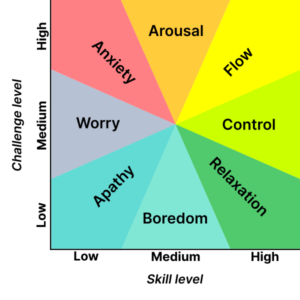
“Flow helps you process emotions without being overwhelmed”
1. Accept Emotions and Feelings: “I’m feeling anxious about this deadline.”
2. Channel It: Redirect the energy into a structured task (e.g., “I’ll use this nervous energy to draft three project ideas”).
3. Reflect Post-Flow: Journal how the activity shifted your mindset.
When Flow Feels Out of Reach?
If you’re stuck in survival mode:
-
Lower the Bar: Start with “good enough” tasks (e.g., “I’ll write one paragraph” vs. a full essay).
-
Pair Flow with Self-Compassion: Acknowledge, “This is hard, but I’m doing what I can.”
If motivation is low, What can I do?

-
Use the “5-Minute Rule”: Commit to 5 minutes of activity—more often until you feel familiar.
-
Gamify It: Turn tasks into a game (“How many emails can I answer in 10 minutes?”)
The key to “Flow”
- No question: do what you have to do.
- Cut feels off: you don’t have to feel anything, No I like it or I don’t like it, change your feel to your focus.
- Open your mind: accept to understand what’s circumstances you at the moment.
- Learn something new: learn a new skill to handle your task.
- Set your goal: change your mindset to achieve your task.
- Just breathe: Deep Inhale – Exhale longer a few times to release your stress.